book
Learn Arabic
You will learn writing, reading and speaking by a proprietary method, and a smart review system will train your memory.
€24.90 a month. Cancel anytime.
Compared
How this differs from the other ways to learn
| Arabų kalbos kursas | Courses in English | Gamified apps |
|---|---|---|
| Language of instruction | ||
| Lithuanian, with Lithuanian mnemonics | English | short notes |
| Vowel marks | ||
| in every lesson, from the first | depends on the course | rarely |
| Grammar | ||
| systematically, with exercises and checking | often a separate course | in passing |
| Handwriting | ||
| stroke by stroke | rarely | none |
| Review | ||
| spaced, by what you are about to forget | you plan it yourself | streaks and points |
Why this course
Everything you need for Arabic, in one place and in Lithuanian.
- From the alphabet to a conversation
- Vocabulary, grammar, reading, listening, pronunciation and spaced review.
- In Lithuanian
- Meanings, mnemonics and grammar are explained in Lithuanian, so you are never learning Arabic through English.
- The lessons run in order
- Each one builds on the last, so there is no jumping between topics and no guessing where to start.
- Fully vocalized
- You meet every new word with its vowel marks. Practice uses fewer and fewer of them, so you learn to read real texts, which have none.
01 The system
IT LOOKS IMPOSSIBLE UNTIL YOU SEE THE SYSTEM
Almost every word grows from a three-consonant root, so once you see the system you stop learning words one at a time.
كkāf
تtāʾ
بbāʾ
02 The root
ك ت ب“to write”
writer
desk
library
ONE ROOT. A WHOLE FAMILY OF WORDS.
03 Five steps
01
Prepare
The words fall into place before the first sentence.
02
Read
You read the Arabic. The translation waits under the line.
03
Listen
You hear it before you say it.
04
Speak
You repeat aloud until it sounds natural.
05
Check
You answer from memory, without going back to the text.
What it looks like
This is what a day in the course looks like.
This is what review, vocabulary and grammar exercises look like.
Today's review
Readكِتَابkitāb
book
kitāb: 'kit-ab'. The kit you carry, and a book is in it.
The system shows the word, you recall the meaning and rate how it went. That rating decides when you see it again.
Vocabulary
كَاتِبkātib
writer
ك ت ب“to write”
- كِتَابbook
- كَاتِبwriter
- مَكْتَبَةlibrary
Every word arrives with the root it grows from, so instead of one word you learn a whole family.
Grammar
هَذِهِ الطَّبَّاخة طَيِّبة.hāḏihi ṭ-ṭabbāḫa ṭayyiba.
This cook is kind.
Answer correct
You answer and see straight away whether it was right. No points and no streaks, only what you know.
Workbook
The Arabic alphabet by hand, stroke by stroke.
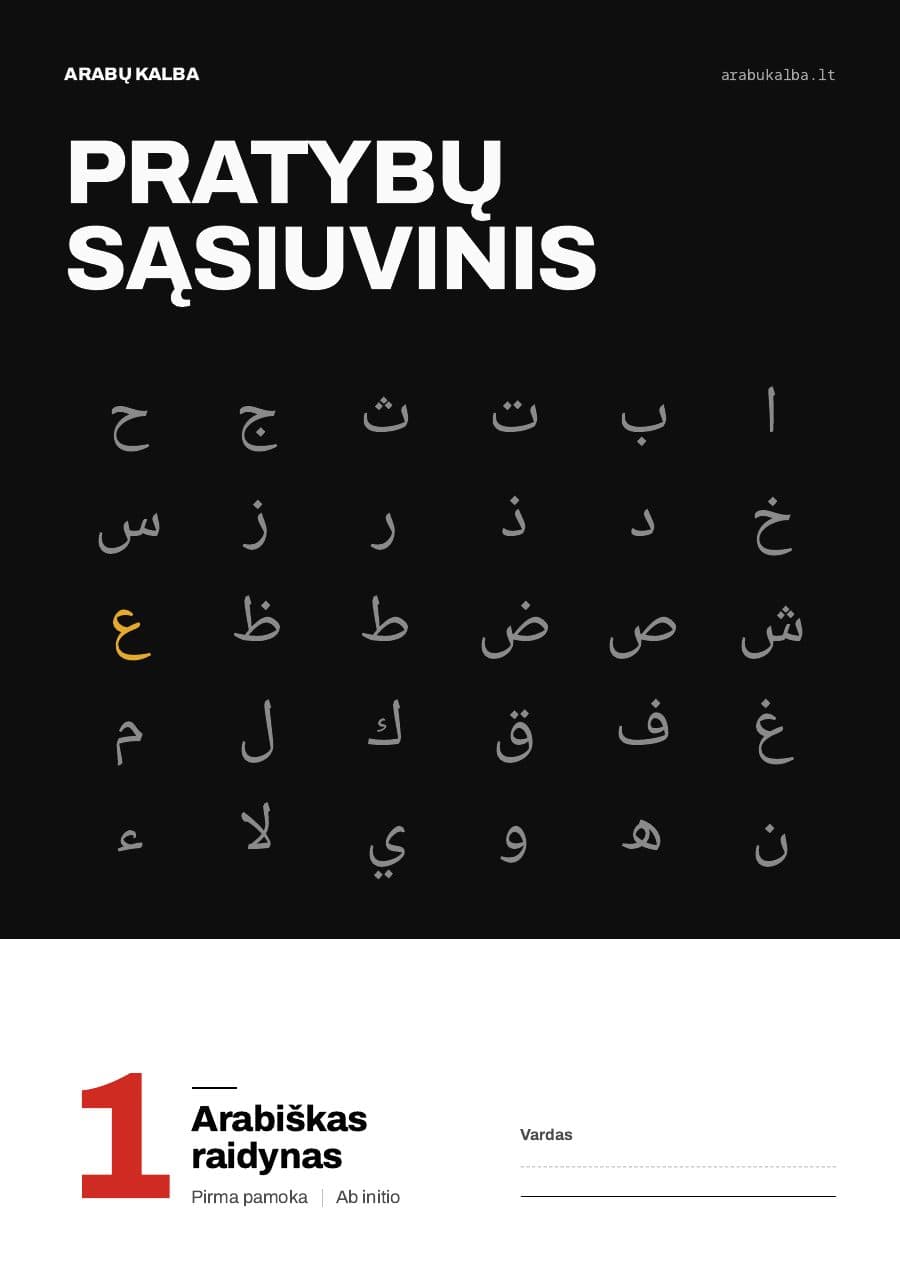
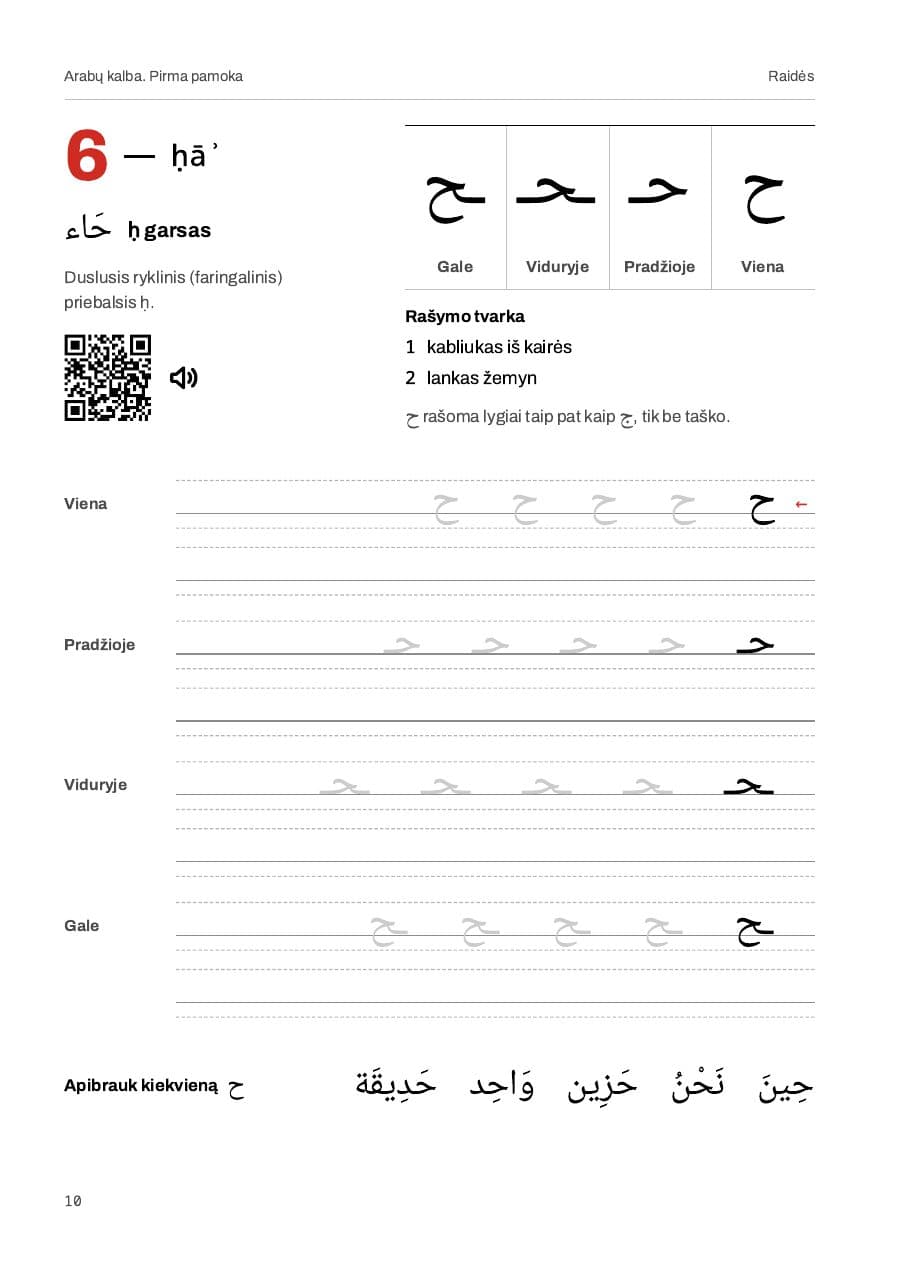
- 29letters
- 36exercises with answers
- 72pages, A4
04 Spaced repetition
YOU REVIEW ONLY WHAT YOU ARE ABOUT TO FORGET
- 1
- 3
- 7
- 21
- 60
Time → days
The system picks what you review today.
05 Why Arabic
A hard language trains the mind
Arabic is built unlike any European language: it runs right to left, and almost every word grows from a three-consonant root. You are not just learning words, you are learning a different way of assembling meaning. Few things exercise memory and attention as thoroughly.
Markets where the language opens doors
The Gulf, Egypt, North Africa: regions where negotiations, contracts and long relationships often begin with whether you greeted someone in their own language.
A rare skill in Lithuania
Almost nobody here speaks Arabic, precisely because it is considered too hard. That is what makes it valuable: little competition, and growing demand.
But won't AI just translate it?
A translator carries information perfectly well. It does not carry the relationship. In a negotiation or someone's home, what matters is not only what was said but that you understood without a middleman: the pause, the register, the joke a second before the subtitle. Machines still flatten dialect and formality toward an average. The person across the table hears the difference immediately.
A key to fourteen centuries of text
The Quran, classical poetry, treatises on medicine and mathematics, calligraphy. This inheritance shaped half the world, and much of it still reads best in the original. A translation explains the content; the rhythm, the sound-play and the deliberate ambiguity only arrive when you read it yourself.
What you actually learn
الْعَرَبِيَّة الْفُصْحَىal-ʿarabiyya al-fuṣḥā
Modern Standard Arabic
This course teaches al-fusha, or Modern Standard Arabic (MSA). It is the shared written language of books, newspapers, official documents and news broadcasts from Morocco to Oman.
06 Levels
You start from zero and go all the way.
A1 is open, and so is the first A2 lesson; the course will grow to B2.
Need an official exam or a diploma? Write to us and we will help arrange one with partner institutions.
- A1Available now
- A2Coming
- B1Coming
- B2The goal
07 The goal
الْكِتَابُ عَلَى الْمَكْتَبِ
al-kitābu ʿalā l-maktabi
“The book is on the desk.” A sentence from lesson two.
A SENTENCE YOU WILL READ YOURSELF.
Arabų kalba
08 Conversation
You can learn to read on your own. Not to speak.
For a live conversation, take one of three paths.
- 01
Community
IncludedWe pair you with another learner at your level, at a time that suits you.
- 02
Teacher
Add-onVetted native speakers and Arabists. Choose, pay, and talk.
- 03
Alija
ComingAn AI conversation partner: you speak Arabic, and Alija answers and corrects your mistakes.
Arabų kalba
09 Start
Start this week
€24.90 / mo or €199 / yr
14-day money-back guaranteeWhy they started
AgnėI wanted to learn, and in Lithuania there is almost nowhere to.
JustasI am preparing to move to the UAE for work.
NojusI met a girl from Jordan. I want to talk with her family.